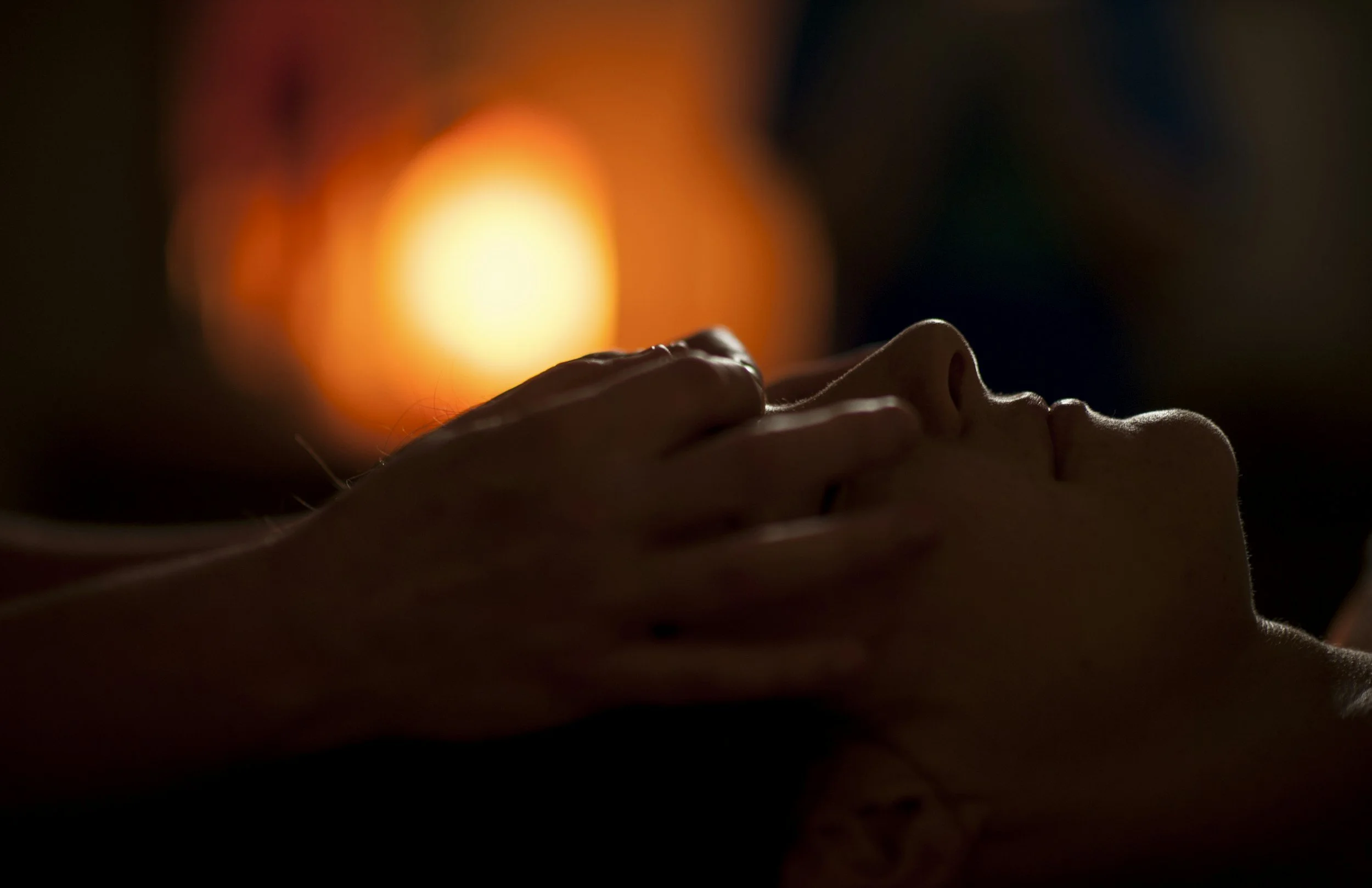
Most people think of tension as something that lives in the shoulders or lower back. Far fewer think about the head. Yet the scalp, temples, and base of the skull are some of the first places the body braces under stress, and some of the last places we think to release.
Head massage is one of the most quietly effective parts of a BONNIE session. Here's what's happening beneath the surface, what the research says about its benefits, and how it fits into the work we do.
The Scalp Is More Than Skin
The scalp is made of several layers, and one of them is a layer of muscle and fascia that wraps over the top of your skull.
The galea aponeurotica. A tough, flat sheet of connective tissue that covers the top of the head like a cap. It links the muscle of the forehead (the frontalis) to the muscle at the back of the head (the occipitalis). Together, they're called the occipitofrontalis. When one end tightens, the whole layer feels it.
The temporalis. A fan-shaped muscle at the sides of your head that helps close the jaw. It's a key reason jaw tension and head tension so often show up together. (Read more in TMJ and Jaw Tension.)
The suboccipitals. Four small pairs of muscles at the base of the skull that help hold and fine-tune the position of your head. They work constantly when you look at screens or hold your head forward.
Because this tissue is continuous with the fascia of the face, jaw, and neck, tension rarely stays in one place. A tight forehead, a clenched jaw, and a stiff neck are often part of the same pattern.
Why the Head Holds So Much Tension
Stress. Furrowing the brow and clenching the jaw are common, often unconscious, responses to pressure.
Screens and focus. Hours of concentrated work, squinting, and holding the head forward keep the forehead, temples, and base of the skull working all day. (Read about tech neck.)
Posture. When the head drifts forward, the muscles at the back of the neck and skull work harder to hold it up.
Poor sleep. Restless sleep and nighttime clenching leave the head and jaw tight by morning.
For many adults in their 30s, 40s, and 50s, these patterns have been building for years, through demanding careers, long days at a desk, and little time to fully rest. That accumulated tension is often felt as a tight band around the head, heaviness by evening, or headaches that start at the base of the skull.
The Benefits of Head Massage
It lowers the body's stress response. In a 2016 study of female office workers, a 15- or 25-minute scalp massage given twice a week for 10 weeks led to significant changes in stress hormones (cortisol and norepinephrine) and blood pressure compared with a control group. Slow, sustained pressure on the scalp signals the nervous system that it's safe to shift out of alertness.
It eases tension in the head, neck, and jaw. Releasing the temples, scalp, and base of the skull takes pressure off connected areas. For many people, this is where tension headaches begin. (See Tension Headaches: Where They Start.)
It softens the face. Because the forehead muscle is part of the same layer as the scalp, releasing the scalp often helps the brow and forehead relax, too.
It supports lymphatic drainage. Lymph from the scalp drains toward lymph nodes behind the ears and at the back of the head, then down through the neck. Gentle work along these pathways, paired with deep breathing, supports that flow. (Learn more in The Lymphatic System 101.)
It supports scalp circulation. Massage increases blood flow to the scalp. One small study found that men who received a 4-minute standardized scalp massage every day for 24 weeks had measurably thicker hair. The research is early and limited, but it's a promising added benefit of a healthy scalp routine.
It helps you rest. Many people find head massage the most deeply relaxing part of a session, and it's common to drift off. That calm can carry into better rest that night.
Head Massage at BONNIE
Head and scalp work is part of every BONNIE session, woven into the larger approach rather than added on.
Myofascial release along the scalp, temples, and base of the skull uses slow, sustained pressure to help the galea and surrounding muscles soften. (How myofascial release works.)
Lymphatic strokes behind the ears and down the neck help guide fluid toward drainage.
Guided breathwork deepens the relaxation response and supports lymph flow.
Calming sound and the occasional ring of bells help the nervous system settle.
Red light therapy closes the session with warmth and supports skin and tissue recovery.
SCULPT (50 min) focuses on the face, head, and neck. POSTURE (50 min) works the upper body and head. Signature (80 min) combines both for the most complete head-to-shoulders release.
A Simple Head Massage You Can Do at Home
A few minutes a day helps extend the results of your sessions.
Find a quiet moment. Before bed or while washing your hair both work well.
Move the scalp, not the hair. Place your fingertips on your scalp and make small, slow circles, moving the skin over the skull rather than rubbing the surface. Work from your hairline to the crown, then down the back of the head.
Release the temples. Use slow circles at the temples for 30 seconds. Unclench your jaw as you do.
Hold the base of the skull. Rest your fingertips in the hollow where your skull meets your neck. Let your head relax back into them for five slow breaths.
Finish with drainage. Stroke lightly from behind your ears down the sides of your neck to your collarbones, five times.
Keep the pressure comfortable. The goal is release, not force.
When to Check With a Doctor First
Skip head massage and talk to a doctor if you have a recent head injury or surgery, an active scalp infection or open wounds, or a sudden, severe, or unusual headache.
Book Your Session
Where: Center City, Philadelphia (19107), a short walk from Jefferson
Services: SCULPT (50 min), POSTURE (50 min), Signature (80 min), all with red light therapy
Pricing: Introductory pricing is available for a limited time
Book online: bonnietherapy.com
Book your Signature session now and let your head finally rest.
Keep Reading
For daily education on fascia, posture, and the nervous system, follow @bonnietherapy on Instagram.
Sources: Kim et al., The effect of a scalp massage on stress hormone, blood pressure, and heart rate of healthy female (2016) · Koyama et al., Standardized Scalp Massage Results in Increased Hair Thickness (2016)