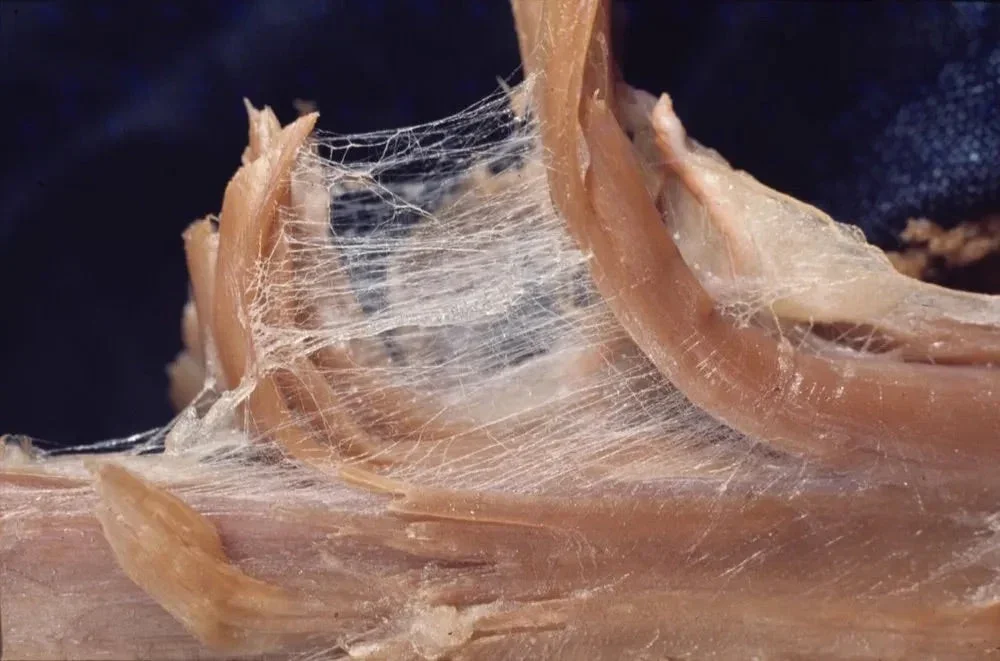
If you've ever had a tight neck that seemed to pull all the way into your shoulder, or a stiff jaw that came with a headache, you've felt fascia at work. It's one of the most important tissues in the body, and one of the least talked about.
At BONNIE, fascia is at the center of everything we do. Here's a simple guide to what it is, why it gets tight, and how to care for it.
What Fascia Is
Fascia is a continuous web of connective tissue, made mostly of collagen, that wraps around and runs through every muscle, bone, nerve, blood vessel, and organ in your body. Think of it like the white layer under the peel of an orange: it surrounds each section, holds everything in place, and connects it all into one whole.
There are three main layers:
Superficial fascia sits just under the skin. It holds fat and fluid and is closely connected to the lymphatic system.
Deep fascia surrounds and separates muscles, helping them glide and transfer force.
Visceral fascia holds the organs in place.
Because it's all connected, tension in one area can be felt somewhere else. A tight upper back can pull on the neck. Tension in the neck can travel up into the scalp and jaw.
What Healthy Fascia Does
Healthy fascia is flexible, hydrated, and slippery. Its layers slide over each other so you can move freely. It:
Gives the body shape and support
Lets muscles move smoothly and work together
Helps transfer force when you walk, lift, and reach
Contains many sensory nerve endings, which help the body sense position and movement
That last point matters. Fascia is rich in nerve endings, so when it's restricted, it can be a real source of stiffness and discomfort.
Why Fascia Gets Tight
Fascia adapts to how you use your body, for better or worse. Common causes of restriction include:
Staying in one position. Hours at a desk or looking down at a phone teach fascia to hold that shape. (More on this in our post on tech neck.)
Repetitive movement. The same motion, day after day, loads the same tissue.
Dehydration. Fascia relies on water to stay slippery. When it's dehydrated, layers can stick together.
Stress. When the body is on alert, muscles brace. Over time, fascia around them stiffens.
Injury or surgery. The body lays down extra collagen to heal, which can limit movement.
Not moving enough. Fascia stays supple through varied, regular movement.
Signs Your Fascia Needs Attention
Stiffness that's worse in the morning or after sitting
A tight jaw, neck, or shoulders that never fully release
Tension headaches that start at the base of the skull (read more about tension headaches)
Limited range of motion when turning your head or lifting your arms
Posture that feels hard to hold, even when you try
How to Care for Your Fascia
Move in different directions. Fascia loves variety. Reach, twist, and bend, not just forward and back.
Hold stretches longer. Fascia responds to slow, sustained stretches. Try holding for 60 to 90 seconds while breathing slowly.
Hydrate steadily. Sip water through the day rather than all at once.
Use gentle self-massage. Light, slow pressure with your hands or a tool like a gua sha stone helps soften the tissue. Dry brushing is another easy daily habit.
Breathe low and slow. Deep, calm breathing helps the body shift out of bracing so tissue can let go.
Try myofascial release. This hands-on technique uses slow, sustained pressure to release restricted fascia. Learn how it works in What Is Myofascial Release?
How BONNIE Works With Fascia
Every BONNIE session combines myofascial and lymphatic techniques with red light therapy, guided breathwork, and sound therapy in a dark, quiet room. The goal is to release tension where it's held and help the nervous system settle so the body can hold that release.
SCULPT (50 min): Face, head, and neck. Reduces puffiness and relaxes facial muscles for a lifted, rested look.
POSTURE (50 min): Upper body and head. Restores mobility so good posture is easier to hold.
Signature (80 min): SCULPT and POSTURE combined.
Not sure which is right for you? Read SCULPT, POSTURE, or Signature: Which Session Is Right for You? or see what to expect at your first session.
Book Your Session
Where: Center City, Philadelphia (19107), a short walk from Jefferson
Services: SCULPT (50 min), POSTURE (50 min), Signature (80 min), all with red light therapy
Pricing: Introductory pricing is available for a limited time
Book online: bonnietherapy.com
Book your session now and give your body the space to let go.
Keep Reading
For stretches, fascia tips, and daily education, follow @bonnietherapy on Instagram.